

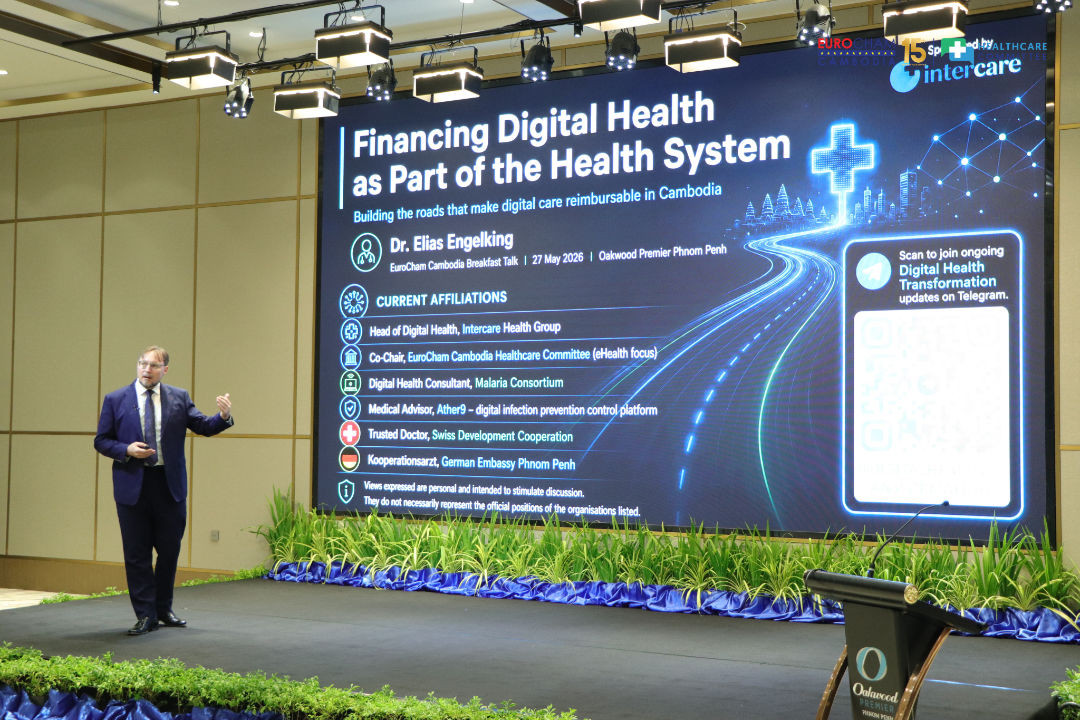
EuroCham Breakfast Talk Calls for Shared Digital Infrastructure to Unlock Sustainable Health Financing in Cambodia./Image supplied.
The European Chamber of Commerce in Cambodia (EuroCham) hosted a breakfast talk on ‘Financing Digital Health — Building the Financing Stack for Digital Care’ on May 27, 2026, bringing together leaders from Cambodia's healthcare, insurance, banking, and government sectors to explore how digital health can be financed in ways that are commercially viable and scalable. Organised by EuroCham's Healthcare Committee, the event featured two keynote presentations and two panel discussions drawing on regional experience and local expertise.
From Pilots to a Sustainable System
Following welcome remarks, Dr Elias Engelking, Co-Chairperson of EuroCham's Healthcare Committee and Head of Digital Health at Intercare Health Group, argued during his presentation that Cambodia's digital health ambitions require shared foundations before financing can follow, including interoperability between health systems, a unified patient identity registry, and common data governance standards.
He pointed to the Cambodia Digital Health Enterprise Architecture, being developed by the Ministry of Health with WHO support, as the national blueprint to align around, and called for the private sector to join forces in a Cambodia Digital Health Alliance — modelled on the Credit Bureau of Cambodia — to build shared infrastructure rather than competing, incompatible systems.
“Fragmentation makes care expensive — for providers, for insurers, and for patients. Cambodia has a real opportunity to do this differently, but we need to build the shared foundations first,” said Dr Engelking. “Just as competing banks came together to create the Credit Bureau of Cambodia, we are calling on the private health sector to join forces and build the shared digital infrastructure that will make sustainable health financing possible.”
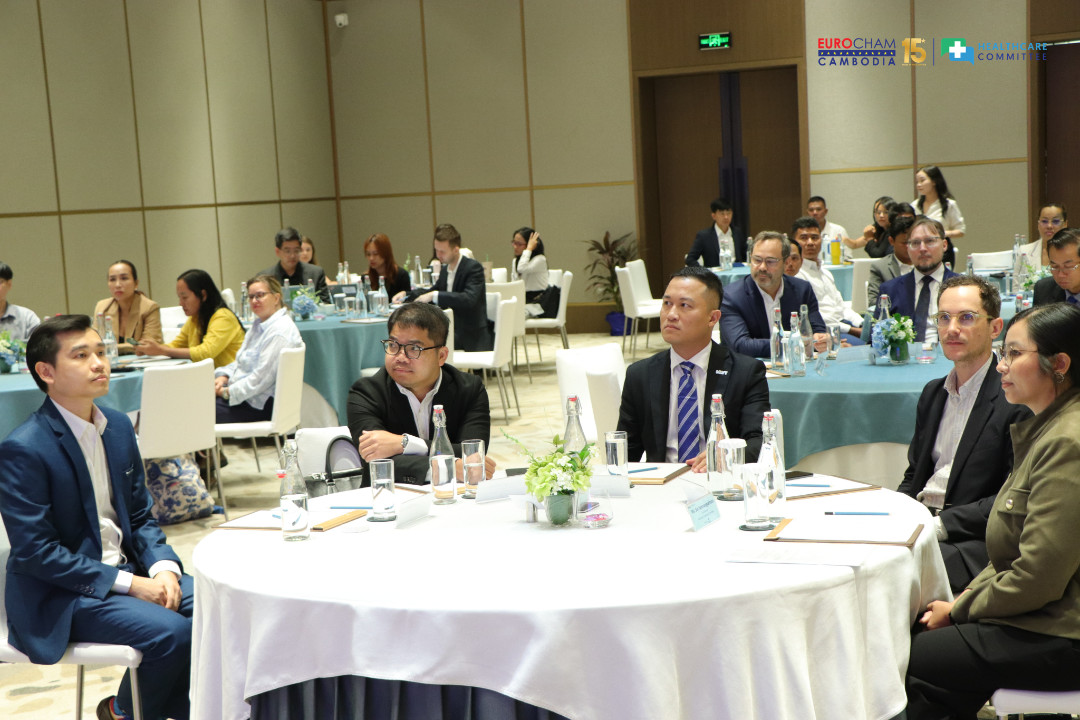
Image supplied.
Edouard Lesellier, CEO of Safetynet, provided a regional snapshot of evolving financing models across ASEAN, noting that no universal health system covers everything, creating a growing role for private insurance as middle-class populations expand. He identified the fee-for-service model as a structural driver of medical inflation and outlined alternatives — including capitation, bundled payments, and value-based care — gaining traction elsewhere in the region. He highlighted Cambodia's smaller scale, high mobile penetration, and absence of legacy systems as genuine advantages in moving faster than larger markets, if the right foundations are built now.
“Cambodia has fewer legacy systems, high mobile penetration, and a more agile market than most of its neighbours; the conditions to build something genuinely forward-looking are all there. But digital infrastructure alone will not solve the sustainability challenge," said Lesellier. "We need to rethink how we pay for care, align incentives between providers and insurers, and design benefit structures that are built to last. The conversation we are having today is exactly where that process needs to start.”
Both panel discussions, moderated respectively by Samnangvathana Sor, Co-Chairwoman of EuroCham's Healthcare Committee, and Dr Engelking, explored the practical pathway from where Cambodia stands today to a more integrated financing system. Panellists agreed that digitalising claims processing — moving to paperless, automated submission — is the most immediately achievable step.

Image supplied.

Image supplied.
During the first panel — featuring Dr. Ebner Yoon, Deputy CEO at Intercare Health Group, and Leng Soklong, Head of Supervision Department of Social Security Regulator, GSNSPC — H.E. Khun Channarith, Deputy Director General of the National Social Security Fund (NSSF), shared that a fully digital patient check-in and claims system has already been successfully piloted at the National Hospital, with full digitalisation of NSSF's claims processing expected by the end of May 2026, and private providers progressively being brought into the network.
Suy Channtharong, CEO of Forte Insurance, offered a compelling proof of concept: through digitalisation and process automation, Forte has reduced claims processing time by 90 per cent, with the vast majority of claims now settled within five to 20 days. Panellists from the hospital, insurance, and regulatory sides, including Dr. Som Leakhena, President of the Private Hospital Associations of Cambodia, discussed the potential for co-payment models and longer-term financing structures, with broad agreement that sustainability will require standardised benefit design, stronger inter-institutional data sharing, and regulatory frameworks to support new models.
On the role of artificial intelligence, Akhshy Thiagarajan of AIA described a mood of cautious optimism among insurers, with AI already showing promise in claims automation and fraud detection but requiring strong data quality and governance to deliver reliably. Dominic Notario, CEO of Canadia Bank, drew on the Credit Bureau experience to argue that meaningful data-sharing in health will likely require regulatory mandate rather than voluntary participation — a lesson the financial sector learned firsthand. Chhay Sothun, Deputy Director of the Department of Digital Health at the Ministry of Health, underlined the importance of a unified patient identity as the cornerstone of any integrated digital health system, and encouraged all private sector actors to align with open national standards as they build.
Closing the event, EuroCham Executive Director, Martin Brisson, highlighted the Healthcare Committee's intention to build on the momentum of the Breakfast Talk with a second digital health forum later in 2026, and welcomed contributions from stakeholders across the sector to shape the agenda.
This press release was supplied.
Comments