


Today we'll discuss one of the most fascinating advances in materials science and chemistry in recent years. A group of researchers from the Institute of Materials Science of Madrid (ICMM-CSIC), in collaboration with other institutions, have filmed the transition states of a chemical reaction in real time (at the nanosecond scale). When two molecules react, they don't go directly from reactants to products, but rather through an intermediate state of maximum energy called a transition state, where old bonds stretch and new ones begin to form.Hoy comentaremos uno de los avances más fascinantes de la química y la física de materiales en los últimos años, un grupo de investigadores del Instituto de Ciencia de Materiales de Madrid (ICMM-CSIC), en colaboración con otras instituciones, han filmado en tiempo real (a escala de nanosegundos) los estados de transición de una reacción química. Cuando dos moléculas reaccionan, no pasan directamente de reactivos a productos sino que pasan por un estado intermedio de máxima energía llamado estado de transición, donde los enlaces viejos se estiran y los nuevos comienzan a formarse.
This state lasts for femtoseconds (quadrillionths of a second) and had always been purely theoretical. What these scientists have done is, using a specific molecule (an organometallic compound based on a phenylene ring bonded to a ruthenium atom), observe in real time how one chemical bond (carbon-iodine) breaks and another (carbon-oxygen) forms, watching the atoms vibrate and rearrange themselves one by one during this process. They have captured the atomic "choreography" of the reaction.
Este estado dura femtosegundos (cuatrillonésimas de segundo) y siempre había sido algo puramente teórico. Lo que esos científicos han hecho es, usando una molécula concreta (un compuesto organometálico basado en un anillo de fenileno unido a un átomo de rutenio), observar cómo se rompe un enlace químico (el carbono-yodo) y cómo se forma otro (carbono-oxígeno) en tiempo real, viendo cómo vibran y se reordenan los átomos uno a uno durante ese proceso. Han captado la "coreografía" atómica de la reacción.
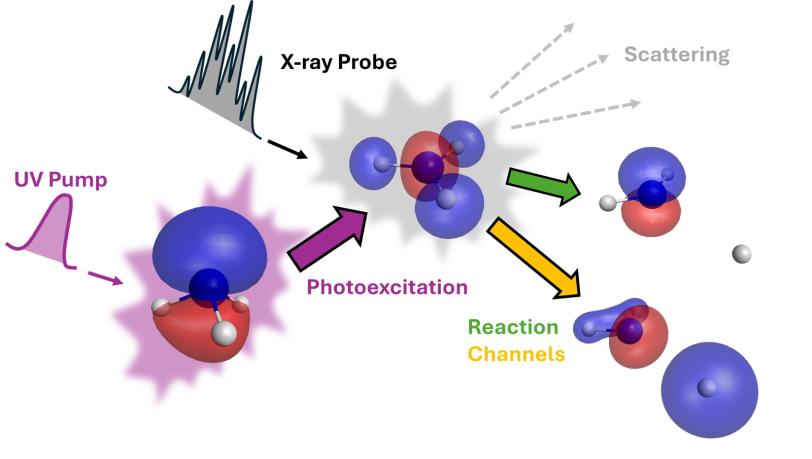
They didn't use a conventional microscope, but rather a powerful combination of two cutting-edge techniques: Scanning Tunneling Microscopy (STM), which allows scientists to "see" individual atoms on a surface but only provides static information (snapshots), and Low-Frequency Raman Spectroscopy (or ultrashort laser pulse probe techniques), which use femtosecond laser pulses (X-rays or ultrafast visible light) to "excite" the molecule and initiate the reaction. The key to the ICMM experiment was synchronizing a "pump" laser pulse (which starts the reaction) with a "probe" laser pulse (which takes a "snapshot" of the molecule's state at that instant).No han usado un microscopio convencional, sino una combinación brutal de dos técnicas de vanguardia, Microscopía de Efecto Túnel (STM) que permite "ver" átomos individuales en una superficie, pero solo da información estática (fotos) y la Espectroscopía Raman de Baja Frecuencia (o técnicas de sonda de pulso láser ultracorto) que utilizan pulsos de luz láser de femtosegundos (rayos X o luz visible ultrarrápida) para "excitar" la molécula e iniciar la reacción. La clave del experimento del ICMM fue sincronizar un pulso láser "bomba" (que inicia la reacción) con un pulso láser "sonda" (que toma una "foto" del estado de la molécula en ese instante).
By varying the time between the pump pulse and the probe pulse (from zero to several hundred femtoseconds), they were able to reconstruct, as if using a stroboscope or a film frame by frame, each atomic step of the reaction. Furthermore, they used a metallic surface (silver) as both a catalyst and a magnifying glass to intensify the vibrational signals of the atoms, something only possible with SERS (Surface Enhanced Raman Spectroscopy). This is not just a scientific curiosity; it's a paradigm shift.
Variando el tiempo entre el pulso bomba y el pulso sonda (desde 0 hasta varios cientos de femtosegundos), pudieron reconstruir, como si fuera un "stroboscopio" o una película de fotogramas, cada paso atómico de la reacción. Además, usaron una superficie metálica (una de plata) como "catalizador" y como "lupa" para intensificar las señales vibracionales de los átomos, algo que solo es posible con la técnica SERS (Espectroscopía Raman Mejorada por Superficie). Esto no es solo una curiosidad científica, es un cambio de paradigma.
Until now, chemists designed catalysts and reactions based on theoretical models and the final product. We knew what went in and what came out, but not how the atoms traveled. Now, by seeing the path, we can understand why certain reactions fail or are slow. It's like going from playing soccer blindfolded to being able to see the ball. By controlling atom by atom, we could drastically reduce the energy needed to manufacture pharmaceuticals, plastics, or fuels. It is estimated that the chemical industry consumes 10% of the world's energy; being able to optimize reactions at the atomic level would mean considerable energy savings.Hasta ahora, los químicos diseñaban catalizadores y reacciones basándose en modelos teóricos y en el producto final. Sabíamos qué entraba y qué salía, pero no cómo viajaban los átomos. Ahora, al ver el camino, podremos entender por qué ciertas reacciones fallan o son lentas. Es como pasar de jugar al fútbol con los ojos vendados a poder ver la pelota. Al controlar átomo por átomo, se podría reducir drásticamente la energía necesaria para fabricar fármacos, plásticos o combustibles. Se estima que la industria química consume el 10% de la energía mundial; poder optimizar reacciones a nivel atómico supondría un ahorro energético considerable.
Observing how bonds vibrate and rearrange themselves in real time allows scientists to validate (or refute) the equations of quantum mechanics applied to large molecules. This opens the door to designing materials with exotic electronic or magnetic properties, controlling their atomic structure with unprecedented precision. The ICMM-CSIC hasn't just taken a pretty picture; it has developed a "video clip" of chemical bonds dancing. This transforms chemistry, once a science of "statistics and probabilities," into a science of "exact atomic engineering." It's the equivalent of what the telescope was to astronomy, but applied to the world of the infinitesimally small and ultrafast.
Observar cómo vibran y se reorganizan los enlaces en tiempo real permite validar (o refutar) las ecuaciones de la mecánica cuántica aplicadas a moléculas grandes. Esto abre la puerta a diseñar materiales con propiedades electrónicas o magnéticas exóticas, controlando su estructura atómica con una precisión sin precedentes. El ICMM-CSIC no ha hecho una foto bonita, ha desarrollado un "videoclip" de los enlaces químicos bailando. Esto convierte a la química, que era una ciencia de "estadísticas y probabilidades", en una ciencia de "ingeniería atómica exacta". Es el equivalente a lo que fue el telescopio para la astronomía, pero aplicado al mundo de lo infinitesimalmente pequeño y ultrarrápido.
 82.207 SRY